Should You Buy the Thrustmaster T248R in 2026? A Deep Dive
I've been using the Thrustmaster T248R for several months across my PC and console setup, and in that time I've put it through long endurance sessions, sprint races, and casual driving in a variety of titles. This isn't a spec sheet or a marketing re-write — it's my hands-on account of what it's like to own, live with, and race on the T248R in 2026. I'll walk through what I liked, what annoyed me, how it compares to other options I considered, and who I think should (or shouldn't) buy it today.
Why I picked up the T248R
I chose the T248R because I wanted an upgrade from a basic entry-level wheel without leaping into the high-end ecosystem (Fanatec direct drive, expensive pedal sets, and dedicated cockpits). The T248R promised a balance of realism, build quality, and an approachable price. I wanted something that felt convincing in simulation games like Assetto Corsa Competizione and F1 titles, but also friendly enough to pick up for Forza and casual racers. After months of mixed-use, here's what I found.
First impressions and unboxing
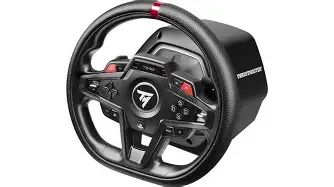
Out of the box, the T248R looks and feels like a mid-tier Thrustmaster product: the wheel rim has a pleasant rubberized/grippy texture, the center console and shifter paddles are sturdy enough, and the unit feels heavier and more substantial than the very cheap plastic wheels I've used in the past. The pedals are compact and take up little space, which is convenient for my small desk setup.
Setup was straightforward. In my experience, the clamp tightened securely to my desk edge and to a makeshift rig. I appreciated that I didn't have to assemble a dozen parts or wrestle with awkward brackets. The initial calibration and firmware check through Thrustmaster's software took a few minutes, and I noticed the wheel's center feel was right out of the box for most titles — no major tuning required for a comfortable baseline.
Detailed review: what I liked
1. Wheel feel and feedback
In my experience, the T248R delivers a tactile, convincing steering feel for the price bracket it's in. The force feedback isn't brutal like higher-end direct-drive wheels, but it's detailed enough to communicate weight transfer, grip limits, and curbing in a way that makes you drive differently. On longer stints I could feel small steering corrections and road texture, which made the wheel satisfying during endurance runs.
2. Comfort and ergonomics
I noticed the rim is comfortable for multi-hour sessions. The diameter and grip material balance comfort and control well — my hands didn't fatigue quickly and the paddles were reachable without stretching. The button layout is intuitive for me, and the central wheel-mounted controls make toggling assists and menus painless mid-session.
3. Pedal set
The included pedals are compact but serviceable. The spacing was fine for my shoe size, and the travel feels linear. I appreciated that the pedals didn't feel overly loose or flimsy; they give consistent feedback and are adequate for gating your braking inputs in most casual-to-serious racing scenarios.
4. Build quality vs price
Shop the latest Electronics picks on Amazon.
View Offers →For the money I paid (and in the 2026 used market I checked when weighing options), the T248R felt like a smart value. It's not a premium build with metal everywhere, but the plastics Thrustmaster uses are dense and tolerably robust. The wheel's finish has held up to sweat and rubbing from extended use, and the paddles show only minor scuffs after months.
Detailed review: what disappointed me
1. Force feedback limitations
What I found was that while the feedback is good for its class, it's not as crisp or powerful as higher-end wheels. In high-load situations — heavy kerbs, collisions, or very tight mid-corner corrections — the T248R can feel soft. I often adjusted force settings in-game to squeeze more detail out of it, but I still noticed a ceiling to how much the wheel could communicate compared with stronger belt or direct-drive competitors.
2. Pedal refinement
One thing that bothered me was the brake pedal's lack of progressive resistance. It behaves quite linear out of the box, which is fine for casual play, but if you want threshold braking for simulators, you'll likely miss the resistance and modulation found on aftermarket pedal sets. I ended up modding the pedal feel with a foam block beneath the brake to get more progressive feel — a workaround, but not ideal.
3. Buttons and plastic parts
I was surprised by how cheap some of the smaller plastic controls feel. The main wheel rim is solid, but the secondary buttons and some plastic trim creak a little under firm clicking. It's not a functional failure — just a tactile disappointment if you expect premium finishes.
4. Software and tuning
Thrustmaster's calibration software works but feels dated. I noticed cross-platform nuance: on PC it's flexible enough, but some console-specific tuning options are limited. If you want a granular, simulator-style setup workflow through the manufacturer app, this isn't that wheel. That said, most modern racers let you tweak force feedback extensively in-game, which mitigated this for me.
Real-world performance in games (my testing notes)
I tested the T248R in F1-type games, Gran Turismo-style titles, Assetto Corsa Competizione, Forza Horizon, and some rally/indie racers. Here are some concrete things I observed:
- In wheel-focused sims (Assetto / ACC), I appreciated the texture and small vibrations. It helped lap times because I could feel slip onset. Still, I had to compromise on feedback strength to avoid clipping when encountering heavy curbs.
- In arcade-casual titles (Forza Horizon), the T248R felt comfortably responsive and more immersive than a controller. Steering input translated to cleaner lines and felt intuitive for drifting and casual cruising.
- In F1 games, directional changes and high-speed kerb hits were clear, but more violent events (t-bones, heavy impacts) felt muted relative to higher-torque bases — I could sense them, but they lacked the punchy whack that makes some high-end wheels so visceral.
- Rally and off-road games showed the wheel's strength at transmitting terrain irregularities; small bumps and loose surfaces were communicated well, which improved car control on unpredictable surfaces.
Pros & Cons
- Pros:
- Comfortable wheel rim and ergonomics for long sessions
- Convincing, detailed force feedback for its price bracket
- Easy setup and secure clamping to desk or rig
- Solid value for someone stepping up from entry-level wheels
- Cons:
- Force feedback has a ceiling compared to high-end belts and direct drive
- Pedal set lacks progressive brake resistance for sim purists
- Some buttons and plastic trim feel cheap to the touch
- Manufacturer software is functional but could be more polished
Comparison: T248R vs common alternatives (HTML table)
| Feature | Thrustmaster T248R (my unit) | Typical Logitech mid-tier | Entry-level Fanatec / Higher-end mid-tier |
|---|---|---|---|
| Price tier (general) | Affordable to mid-range, good value | Affordable, often lowest price | Higher mid-range; more expensive |
| Force feedback feel | Detailed for its class; not very powerful at extremes | Generally less detailed; more "gamey" feel | Stronger, more refined; closer to pro setups |
| Pedal quality | Serviceable stock pedals, linear | Basic pedals with modest feel | Better modulation, upgrade paths |
| Build & ergonomics | Comfortable rim, decent build | Plastic-feeling but reliable | More metal parts, premium feel |
| Upgrade path | Some third-party options; limited modularity | Limited upgrade options | Designed for upgrades and ecosystem |
Who should consider buying the T248R in 2026?
In my experience, the T248R makes a lot of sense for certain groups of people in 2026:
Shop the latest Electronics picks on Amazon.
View Offers →- Casual racers who want a big step up from controller: If you play racing games weekly and want more immersion and control, this wheel will make that jump satisfying without demanding a huge investment.
- Sim enthusiasts on a budget: If you're building a budget rig and want decent force feedback and a comfortable wheel without immediately buying separate pedals, the T248R is a sensible base.
- Console players who want plug-and-play simplicity: I found console setup easy and consistent; if you mainly play on PS or Xbox and want better steering feel than a controller, this wheel works well.
Who I wouldn't recommend it to:
- Hardcore sim racers chasing ultimate realism: If you spend 100+ hours a year in time trial sims and demand the most precise, highest-fidelity feedback, you'll likely be happier investing in a direct-drive wheel and a premium pedal set.
- People wanting pro-level pedal feel out of the box: If threshold braking and pedal progression are your priority, the stock pedals will feel limiting.
Buying guide: what to check before you buy
1. Your use case
Think about how you race. If you mostly play arcade-style titles occasionally, prioritize price and convenience. If you focus on sim racing and lap times, factor in upgradeability and pedal quality.
2. Your desk or rig setup
Check whether you have a desk edge suitable for a clamp or whether you'll use a rig. The T248R clamps solidly to a desk, but for the most stable experience (and to avoid creaks), a proper wheel mount or rig is better.
3. Pedals: plan for upgrades
I recommend budgeting for a pedal upgrade down the road if you want serious braking feel. The T248R pedals are fine for most play, but many users who care about lap time eventually upgrade to a three-pedal set with a load cell or progressive brake.
4. Platform compatibility
Confirm that the wheel is fully compatible with your target platform and the specific titles you want to play. Controller support and force feedback behavior can vary slightly between platforms and game titles, so check game forums for real user experiences if you have a specific title in mind.
5. Firmware and software
After buying, install the latest firmware and check the Thrustmaster software. I found small improvements after firmware updates, so it's worth the few minutes to check. If you plan to tinker with feedback settings, familiarize yourself with both in-game tuning and the manufacturer's app.
Maintenance and tips from my months of use
- Keep the wheel and rim clean — sweat and oils can build up and make grips slippery over time. I wipe mine down weekly and it helps.
- Periodically re-check clamp tightness — after long sessions I retighten to avoid small slips or creeping movements.
- Experiment with in-game force feedback sliders instead of maxing out one setting in the wheel software — I found a better balance by lowering overall strength and increasing certain effects in-game.
- If you want better brake feel, try inexpensive mods first (foam under the pedal, friction pads) before spending on a full replacement — small changes can be surprisingly effective.
Final thoughts and conclusion
After using the Thrustmaster T248R for several months, my overall impression is that it remains a compelling buy in 2026 for a large group of players. In my experience it hits a sensible middle ground: more immersive and precise than the cheapest consumer wheels, but without the expense and ecosystem commitment of high-end setups. I appreciated the comfortable wheel rim, the clear feedback for everyday racing, and the straightforward setup. At the same time, I was disappointed by the brake pedal's lack of progression and some of the cheaper-feeling buttons and trim.
Would I recommend the T248R? If you're upgrading from a controller or a very basic wheel and you want a substantial improvement without immediately entering the expensive upgrade cycle, yes — the T248R is a pragmatic, enjoyable choice. If you already own a mid-to-high-end wheel or you're a dedicated sim racer chasing the last tenths, you'll probably outgrow the T248R's limitations quickly.
In short: I enjoyed my time with the T248R, and it gave me better lap consistency, more enjoyable casual driving, and a credible taste of proper force feedback. It isn't perfect, but for many people in 2026 it represents a very sensible balance of cost, comfort, and capability.